
The church parking lot was empty at 7 a.m. except for a 12-year-old Labrador, 78 pounds and stiff through the hips, and his owner holding a leash in one hand and a tennis ball she had decided not to throw in the other. He pulled toward his old fetch corner, then stopped after twenty yards with a shortened stride and a look back that asked for help. She wanted to know whether walking him at all was kind or cruel. That question is the whole decision in senior arthritis care, and my answer as a clinician who thinks in movement, comfort, and quality of life is consistent: controlled, low-impact movement most days supports comfort better than rest alone.
A joint with osteoarthritis is not simply worn out. Cartilage turnover slows, the synovial fluid that lubricates and nourishes cartilage changes character, and the muscles around the joint weaken from disuse. Research on joint biology still describes chondroitin in careful structure terms as an ingredient that supports healthy synovial fluid homeostasis, according to Frontiers in Veterinary Science. Supplements alone cannot rebuild that system. Rhythmic loading from walking, swimming, and weight-shifting is what moves synovial fluid, maintains range, and preserves the muscle that unloads a sore joint.
Why short and frequent beats long and occasional
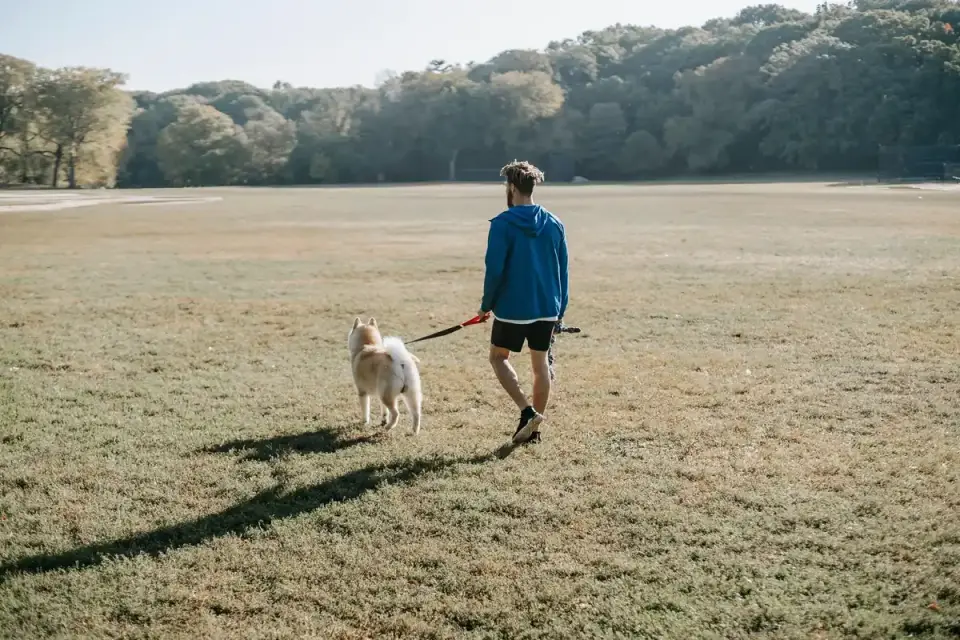
Meet older dogs and their people where they are, which for most arthritic seniors means two or three brief walks rather than one long outing. A useful starting dose is a 10 to 15 minute leash walk on soft, level ground at the dog’s pace, with sniff breaks allowed, followed by a check two hours later and the next morning. If stiffness is no worse, that dose fits. If the dog lags, lies down, pants heavily, or is markedly stiffer by evening, shorten the next outing by half.
Flat loops work better than out-and-back routes. A loop lets you cut across to the car when you see fatigue. Grass, packed dirt, and rubberized track surfaces spare joints. Avoid steep hills, slick floors, sprint fetch, and weekend catch-up hikes that overload tissues deconditioned during the week.
Movement matters more than any chew, a point I return to when owners ask about the best joint supplement for dogs and whether a new formula can replace walks. In related writing on what Rimadyl is actually doing compared with joint chews, the same principle holds: medication and nutrition may help support mobility, but only movement preserves strength and joint excursion.
The water, the slope, and the living room floor
Swimming and underwater treadmill work suit many seniors because buoyancy unloads joints while resistance builds hind-limb muscle. Keep sessions brief and supervised, with a well-fitted life vest, warm water when possible, and a ramp entry rather than jumping from a dock. Five to ten minutes of steady paddling with rest breaks is plenty to start.
Three weeks in, a 14-year-old, 42-pound Australian cattle dog mix showed why more is not always better. Her owner, encouraged by a good first swim, booked daily 25-minute lake retrieves for a week. By day five the dog hesitated to rise from her bed, needed coaxing down two porch steps, and carried her left hind through the first dozen steps each morning. We cut swimming to twice weekly for eight minutes, replaced retrieves with leash wading, and added five minutes of indoor weight-shifting on a yoga mat. Within ten days her morning rise time shortened and she resumed her evening block without pausing. The failed approach was understandable enthusiasm, yet arthritic tissue adapts to consistency, not intensity.
At home, favor traction, gentle grades, and proprioception over tricks. Place runners over hardwood, use a ramp for the car and couch, and practice three to five repetitions of sit-to-stand on a non-slip surface, cookie stretches to each hip, and slow cavaletti steps over a broom handle laid on the ground. Stop each exercise while the dog still wants one more repetition.
When rest is the right prescription
There is a strong counterargument to my bias toward movement. Some clinicians argue that an acutely flared joint needs complete rest until pain resolves, and they are right for the short term. A hot, swollen joint, a sudden non-weight-bearing lameness, vocalizing on manipulation, or fever after exercise means pause movement and call your veterinarian promptly rather than pushing through.
The distinction is flare versus baseline. Baseline arthritis in seniors responds to daily motion. Flares respond to rest, reassessment, and veterinary guidance on pain control.
That edge case appeared last winter with a 10-year-old, 96-pound Bernese Mountain Dog with bilateral elbow arthritis and early laryngeal paralysis. His owner had built a careful routine of two 12-minute walks daily, and by day 10 his gait looked smoother and his nighttime restlessness eased. Then cold air triggered coughing and exercise intolerance unrelated to his joints. We shifted his joint plan entirely indoors for two weeks: three four-minute hallway walks, passive range of motion while he lay on his side, and standing balance with gentle hip sways instead of cold-air outings. His elbows stayed supple without stressing his airway. For dogs with cardiac, neurologic, or respiratory disease layered over arthritis, the safest exercise is sometimes the smallest one, dosed around the other condition.
Glucosamine research offers a modest parallel for this realistic framing. Laboratory work found that glucosamine could prevent experimentally induced cartilage degradation in vitro, as reported by the Journal of Veterinary Medical Science. In vitro is not in your dog’s hip. It suggests biological plausibility for supporting joint structures, not a promise that a chew restores cartilage or replaces the slow work of muscle maintenance.
A brief recap: walk short and level most days, add water or gentle strength work where available, adjust by the two-hour and next-morning check, and rest flares. That rhythm, held across months, is how gray-muzzled dogs keep the comfort and quality of life their people hope movement can still provide.
Frequently asked questions
How long should I walk a senior dog with arthritis?
Many clinicians start with 10 to 15 minutes on soft, level ground once or twice daily at the dog's pace, then adjust based on stiffness two hours later and the next morning. Shorter and more frequent is usually better tolerated than a single long walk.
Is swimming good for dogs with arthritis?
Supervised swimming or wading often suits arthritic seniors because water unloads joints while building muscle. Keep entries gradual with a ramp, use a life vest, start with five to ten minutes including rest breaks, and skip cold water or repeated jumping retrieves.
Should an arthritic dog rest completely on bad days?
Reduce activity during a flare marked by heat, swelling, sudden lameness, or pain on handling, and contact your veterinarian for guidance. For baseline stiffness without those warning signs, brief gentle movement usually supports comfort better than full-day crate rest.
Sources
- Chondroitin and synovial fluid homeostasis in joint support — Frontiers in Veterinary Science
- Glucosamine and experimentally induced cartilage degradation in vitro — Journal of Veterinary Medical Science