Your First Week Home With a Working-Breed Puppy
Here's what I actually tell owners the night before a working-breed puppy comes home, not the sanitized version.
On this page
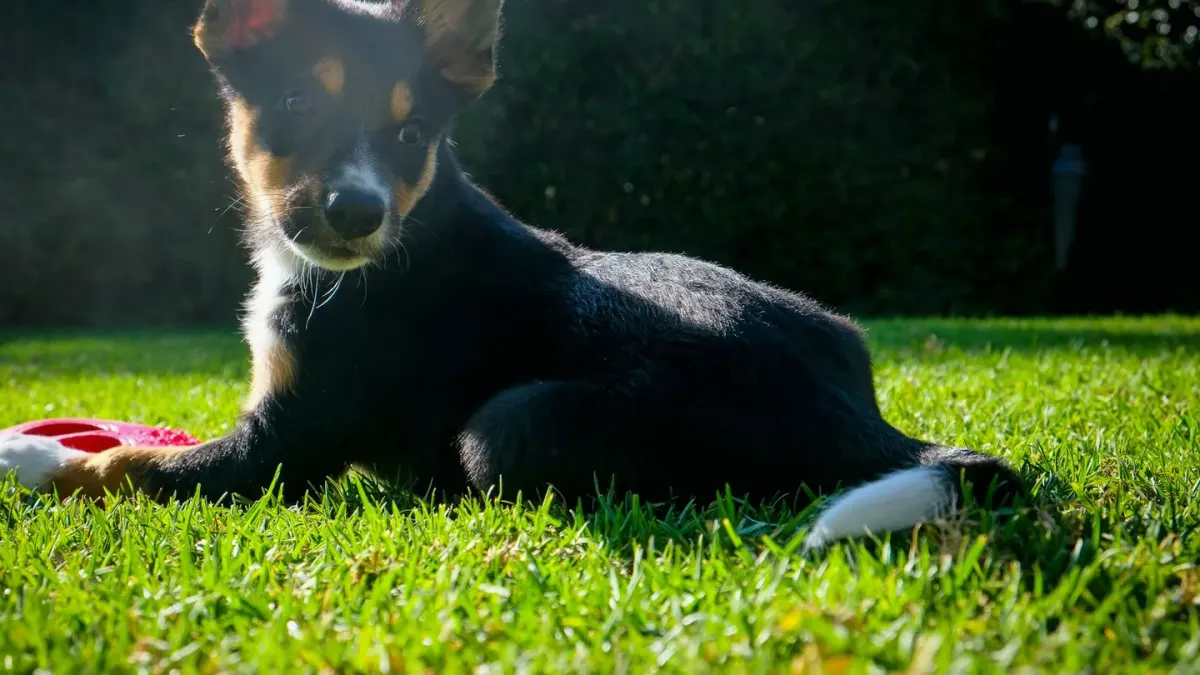
A Border Collie puppy named Otter came into my exam room on a Tuesday morning, eleven weeks old, nine pounds, two days into his new home. His owners were exhausted and a little defensive. He’d already jumped off the couch twice, barked at the vacuum for ten straight minutes, and refused to settle unless someone was touching him. They wanted to know if this was normal, and they wanted a plan, not reassurance.
It is normal. And there is a plan.
What I actually tell owners the night before pickup
Working breeds — Border Collies, Australian Shepherds, German Shepherds, Vizslas, Belgian Malinois, and their mixes — are not harder puppies than a Cavalier or a Frenchie. They are puppies with a narrower margin for boredom and a body that grows faster than their judgment. The first week sets the pattern for both. I tell owners three things before the puppy is even in the car: keep the world small on purpose, protect the joints even though nothing looks fragile, and start the vaccine and vet-visit clock on day one, not week three.
The exposure window is already closing
Here’s the part that surprises most new owners: the single highest-leverage thing you do in week one isn’t training a sit. It’s exposure. The American Veterinary Society of Animal Behavior identifies the first three months of a puppy’s life as the primary window in which sociability outweighs fear — the period when new people, sounds, surfaces, and mild novelty are processed as interesting rather than threatening. AVSAB’s position is that this socialization should begin before vaccines are complete, because incomplete socialization carries more real-world risk for most puppies than a well-managed, low-exposure outing.
That doesn’t mean the dog park at eight weeks. It means low-risk, high-volume exposure: carrying the puppy through a hardware store, letting him watch traffic from a parking lot at a distance, inviting one calm, vaccinated adult dog over. Working breeds in particular tend to notice everything — a slamming door, a skateboard, a stranger in a hat — and how they process that first exposure sets the template for how they process the next hundred.
I’ve watched this play out differently in two Border Collie littermates I saw a year apart. One owner did five minutes of new-surface, new-sound exposure daily starting the day the puppy came home — different flooring, a vacuum at a distance, a car ride to nowhere in particular. The other owner, understandably overwhelmed with a new job and a new puppy, mostly kept the dog in the yard and house for the first month “until the shots were done.” At the one-year recheck, the first dog was reactive to almost nothing new. The second was still working through noise sensitivity with a trainer. Same breed, same genetics as far as I could tell, very different first three months.
Joints don’t look fragile, but they are
This is the piece I push back on hardest, because it’s the one owners resist. A ten-week-old working-breed puppy looks sturdy — thick paws, a solid chest, boundless energy — and that appearance is misleading. According to VCA Hospitals, growth plates in large and giant-breed dogs typically don’t close until 18 to 20 months of age, and before that point they are genuinely fragile: repetitive impact, forced running, and repeated jumping on and off furniture can cause micro-trauma that leads to premature closure or uneven limb growth. That’s not a hypothetical outcome — it’s the mechanism behind a fair number of the early-onset hip and elbow cases I see later.
So in week one specifically: no jumping in and out of the car, no stairs unsupervised, no structured running or forced retrieving on hard pavement. Free play in short bursts on soft ground — grass, dirt — is fine and honestly good for coordination. What’s not fine is treating a nine-week-old body like it can handle what a nine-week-old brain wants to do.
The vet-visit and vaccine clock starts now, not later
Working breeds tend to be high-energy and high-exposure by nature — farm visits, trail walks, dog-sport foundations started early — which makes the vaccination timeline more relevant, not less. Per the American Animal Hospital Association, core puppy vaccines against distemper, parvovirus, and adenovirus typically begin at 6 to 8 weeks of age and repeat every 3 to 4 weeks until roughly 16 weeks, with a rabies vaccine given once in the 12-to-16-week window. If your puppy’s schedule isn’t already started by pickup day, get the first appointment on the books before the end of week one — not because socialization should wait for it, but because the two need to run in parallel, not in sequence.
I also use that first visit to establish baseline weight and a rough growth-rate expectation, since working breeds that grow unusually fast for their frame are the ones I watch most closely for joint strain later.
What a realistic week looks like
Day one and two are for decompression, not training — let the puppy sleep more than you’d expect and don’t force interaction with visitors. By day three, start short, low-stakes outings: a driveway, a quiet parking lot, a neighbor’s porch. By day five, book or confirm the first vet visit if it isn’t already scheduled. Throughout the week, keep exercise to free play on soft surfaces in five-to-ten-minute bursts, several times a day, rather than one long walk. If you’re comparing breeds before you even bring a puppy home, resources like our guide on best low-maintenance dog breeds for busy people or the breakdown of Border Collie vs Australian Shepherd temperament differences are worth reading first — working breeds are not interchangeable, and the first week goes more smoothly when the breed match was honest to begin with.
What I’d tell you if you asked me directly
If I had to defend one recommendation above the rest, it’s this: front-load exposure over exercise. The instinct with a working breed is to burn off energy, and that instinct is wrong in week one. A tired-out puppy from forced exercise is a puppy whose joints took the hit; a well-exposed puppy from five minutes of new sights and sounds a day is a puppy whose nervous system got the benefit. The counterargument I hear most is that a high-drive breed “needs” to run — and there’s truth in it eventually, just not yet. The body isn’t ready, even when the attitude clearly is.

Frequently asked questions
When can a working-breed puppy start running with me?
Most vets recommend waiting until 18 to 20 months for large and giant breeds, once growth plates have closed, per VCA Hospitals guidance on puppy exercise.
Is it safe to take a puppy out before vaccines are finished?
Low-risk, well-managed exposure — carried outings, calm vaccinated dogs, new environments avoiding high-traffic dog areas — is supported by AVSAB, which considers the socialization window more urgent than waiting out the full vaccine series.
Sources
- AVSAB Position Statement on Puppy Socialization — American Veterinary Society of Animal Behavior
- How Exercise Can Damage Puppy Growth Plates — VCA Hospitals
- 2022 AAHA Canine Vaccination Guidelines — American Animal Hospital Association