Play Bow or Aggression? Reading Dog-to-Dog Signals
Medically reviewed by Jessica Ennis, DVM, CVA — For general education — not a substitute for veterinary care.
You can usually tell dogs are playing versus fighting by watching whether either dog will voluntarily pause and come back for more.
On this page
The dog park was nearly empty on a Tuesday evening when I watched a Lab mix I’d examined that morning — a wiry two-year-old named Cooper, about 55 pounds — barrel into a Bernese mountain dog three times his size. Cooper’s owner froze. The Bernese went down on his front legs, rear end skyward, tail going in a full circle, and Cooper immediately mirrored him. What followed looked, to an untrained eye, like chaos: open-mouthed biting at necks, bodies slamming into the grass, a growl that carried across the parking lot. It lasted about four minutes, with three separate pauses where both dogs stood, shook off, and then dove back in. Nobody got hurt. That’s the scene I want you to hold onto, because almost everything owners get wrong about reading dogs comes down to listening to the noise instead of watching the rhythm.
Verdict up front: the single most reliable tell isn’t volume, growling, or even bared teeth — it’s whether the interaction self-interrupts and both dogs choose to restart it. Real play has brakes. Real conflict doesn’t.
Why the noise fools almost everyone
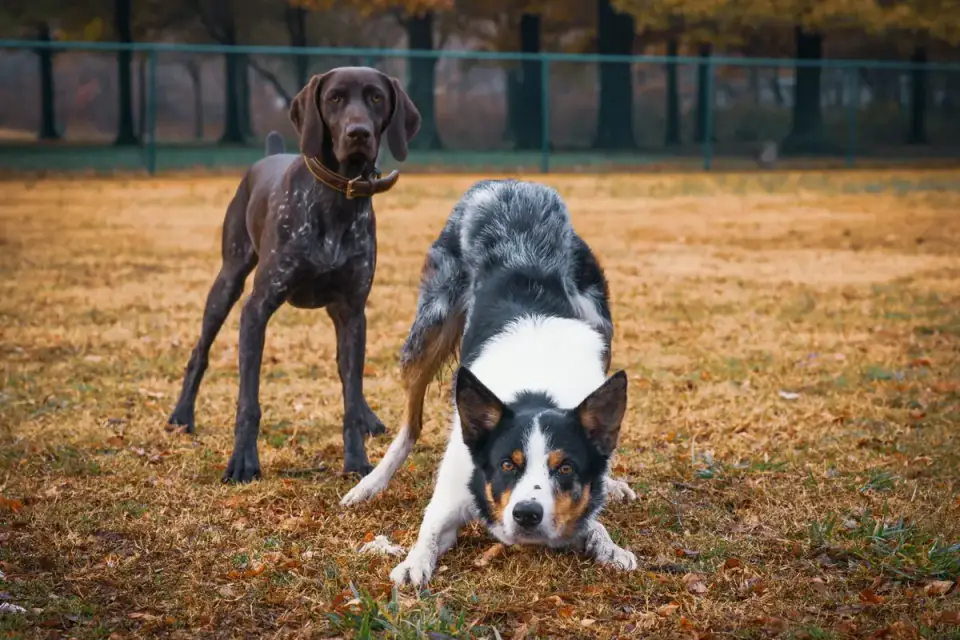
Growling, snarling, and even the occasional yelp are normal soundtrack for dog play, which is exactly why so many well-meaning owners intervene at the wrong moment, or worse, don’t intervene when they should. Dogs use exaggerated, “louder” versions of predatory and combative behaviors — chasing, mouthing, body-slamming — specifically because the exaggeration itself is part of the signal. A dog play-bow, with the front legs stretched forward and the hindquarters raised, functions as a kind of punctuation mark that tells a play partner “everything after this is not what it looks like,” according to the AKC. You’ll often see it at the start of an encounter and then again mid-play, as a reset after something got a little too rough.
What you should actually be scanning for is looseness. A dog engaged in real play has a bouncy, loose-limbed gait, a relaxed or open mouth, and soft eyes — not the fixed stare, stiff spine, and raised hackles of a dog who’s escalating toward a fight. The American Veterinary Society of Animal Behavior describes ears held high and back, a loosely wagging tail at roughly half-mast, and a soft, open mouth as comfort signals; a stiff, still body held with tension is the posture more likely to precede a snap or bite if the other dog keeps pressing.
The role-reversal test
If I had to give an owner one rule to use in the moment, it’s this: watch who’s winning. In genuine play, the bigger, faster, or more confident dog will periodically let the other dog “win” — flop onto his back, slow down enough to get caught, or take a turn being chased instead of chasing. That give-and-take, sometimes called self-handicapping, is one of the clearest markers that both dogs are still choosing to participate. When one dog is always on top, always the pursuer, and the other never gets a turn or a break, the balance has tipped from play into something the smaller or less willing dog didn’t sign up for — even if no growling has started yet.
Pauses matter just as much as reversals. Healthy play checks in with itself. Dogs stop, shake off, sniff the ground, glance at each other, and then decide — together — to resume. A fight doesn’t pause and resume by mutual choice; it either ends because one dog disengages and leaves, or it escalates. If you clap your hands or call out and the dogs don’t so much as glance over, that’s worth noting too — play usually allows for that kind of interruptibility, since neither dog is in a truly aroused state.
When it’s already gone wrong
I’ve watched this play out with clients more times than I can count: an owner calls in a panic because their dog “just snapped out of nowhere” during what looked like normal roughhousing. Almost always, when we walk back through it, the warning signs were there — a dog who’d stopped initiating pauses, a partner who kept pinning without letting go, a stiffening posture in the fifteen seconds before the bite. One case that’s stuck with me was a young Australian Shepherd, about a year old, whose owner described her suddenly “losing it” at daycare after roughly ten minutes of wrestling with a housemate dog. On review, the shepherd had tried to walk away twice and been chased down both times before the actual conflict started. The signal she’d been giving — increasing distance, a lowered tail, no more reciprocal chasing — had been there the whole time; it just hadn’t registered as one.
If a scuffle does break out, don’t grab collars or reach into the middle of it — a startle bite redirected onto a hand is common. A loud interrupt (a clap, a sharp “hey,” an air horn if you carry one) and physically separating the dogs by the leash or body-blocking is safer than reaching in. Afterward, keep the dogs apart long enough for both to settle rather than immediately re-introducing them to “work it out.”
What lingers after a real conflict — and what doesn’t fix it
A dog who’s actually been in a fight, even a brief one, often carries that arousal for a while: panting that doesn’t match the temperature, pacing, refusing food he’d normally take, or unusual clinginess for the rest of the day. That’s a stress response, not a character flaw, and it’s worth giving the dog quiet time to come down rather than pushing another social introduction the same afternoon.
Some owners ask about calming support for a dog who’s chronically reactive or anxious around other dogs — worth naming honestly, because the evidence is real but modest, and it’s not a substitute for the training and management work above. Chamomile and valerian root have a long history of traditional herbal use to support relaxation, though for most species the supporting evidence is still drawn mainly from preclinical studies or traditional use rather than large trials, according to a review published in Biomedicines. L-theanine, an amino acid naturally found in tea, has been studied for calming properties in humans; one analysis found a meaningful effect in a study using 400 mg/day over eight weeks, though that finding came from work on psychotic anxiety specifically, per a review in Molecular Psychiatry. KSM-66 ashwagandha has more consolidated human evidence behind it — a systematic review in Cureus that pooled multiple randomized controlled trials concluded it has a moderate positive impact on stress reduction and cognitive performance. None of that stands in for reading the dog in front of you, but for owners weighing which calming ingredient might suit an anxious dog, we’ve written a longer comparison of chamomile vs L-tryptophan for calming dogs that goes deeper on dosing context and evidence quality.
If the underlying issue is a dog who reacts defensively before another dog even gets close, that’s a different problem than play misread as fighting, and it’s worth reading through our piece on why some dogs growl when petted — a lot of the same body-language literacy applies.
The scene that changed how I explain this
A few years ago I had a client bring in her nine-year-old Golden Retriever, Daisy, after a “fight” at the dog run that had actually just been two dogs play-wrestling too close to a fence, startling a third dog who then genuinely attacked. The owner had watched the whole thing and still couldn’t tell me, minute by minute, when it stopped being play. What she remembered was noise — a lot of it, the whole time — and that’s what had made her freeze instead of stepping in early. We spent twenty minutes afterward going through what to watch for instead: the pause after thirty seconds that didn’t happen, the third dog’s tail going from a loose wag to tucked, the stiffening along his spine before he lunged. She told me months later that she’d used that checklist at the same dog run and pulled her dog out early from an encounter that would have gone the same way. That’s really the whole point of learning to read this — not becoming fearful of normal roughhousing, but catching the two or three seconds where a dog is telling you, clearly, that he wants out.
Looking ahead
The more time you spend actually watching dogs interact — rather than listening to them — the faster this becomes intuitive. Start by muting the sound in your head and watching for one thing: does either dog get to choose to stop? If both dogs keep choosing to come back, you’re watching play. If one dog is only along for the ride, it’s time to step in before biology answers the question for you.
Frequently asked questions
What's the single fastest way to tell if dogs are playing or fighting?
Watch for role reversal and voluntary pauses. If the same dog is always chasing, always on top, and the interaction never pauses and restarts by mutual choice, treat it as a warning sign rather than play — regardless of how loud it sounds.
Is growling always a bad sign between dogs?
No. Growling, snarling, and mock-biting are common in normal dog play, especially paired with a loose body, a play bow, and pauses to reset. What matters more than the sound is the body posture and whether both dogs keep choosing to continue.
Should I ever physically separate playing dogs just to be safe?
If you're genuinely unsure, a brief interruption — a clap, a recall cue, calling your dog away — is a reasonable way to check in. Dogs who are truly playing will usually be easy to redirect and often go right back to it; a dog in real conflict may not respond to the interruption at all.
Sources
- Are Dogs Playing or Fighting? How to Tell the Difference — AKC
- Understanding Canine Facial Expressions and Body Postures — American Veterinary Society of Animal Behavior
- Chamomile × Anxiety & Stress systematic review — Biomedicines
- L-Theanine × Anxiety & Stress review — Molecular Psychiatry
- KSM-66 Ashwagandha × Anxiety & Stress systematic review — Cureus